RE.CK
Recycled. Universal. Future-proof.
Efficient construction using recycled building waste
The innovation
The RE.CK recycled block was developed by Alfons Schwiderski from May 2024 onwards specifically for use in post-conflict and reconstruction contexts, with the aim of enabling its production on machinery already available in those areas.
The block’s shape follows a deliberately simple tongue-and-groove design, which prevents lateral movement of the wall, allows for controlled longitudinal displacement and thus offers particular advantages in earthquake-prone areas, as movement joints absorb forces and help to reduce damage.
Weighing around 11 kg, the block is sized so that it can be moved and installed by hand in an emergency, whilst at the same time being optimised for mass, machine-based production. A key design criterion is the elimination of mortar: the load-bearing capacity of the walls is derived from their own weight, vertical loads and friction, meaning that semi-skilled workers without specialist bricklaying qualifications can carry out the construction, and the buildings remain dismantlable at a later date (Cradle-to-Cradle principle).

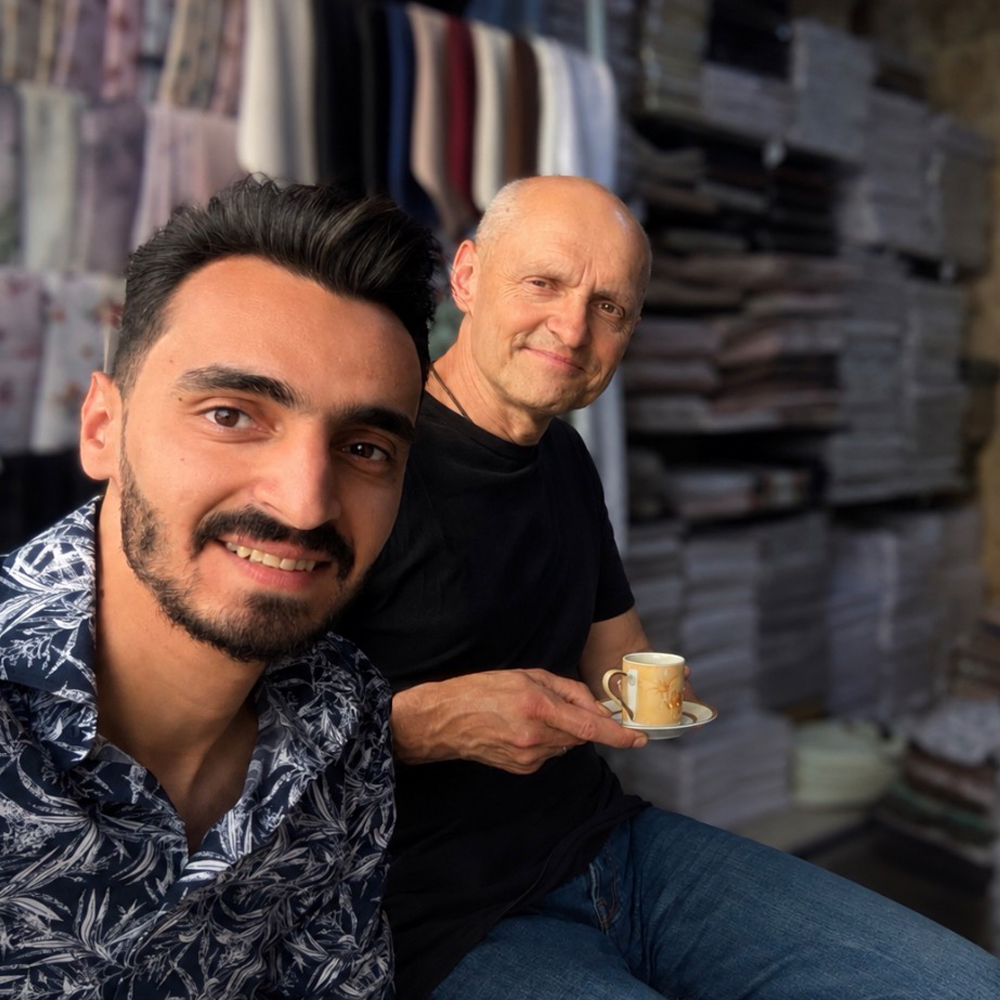
Inventor Alfons Schwiderski and draughtsman Omar Halima with the RE.CK prototype
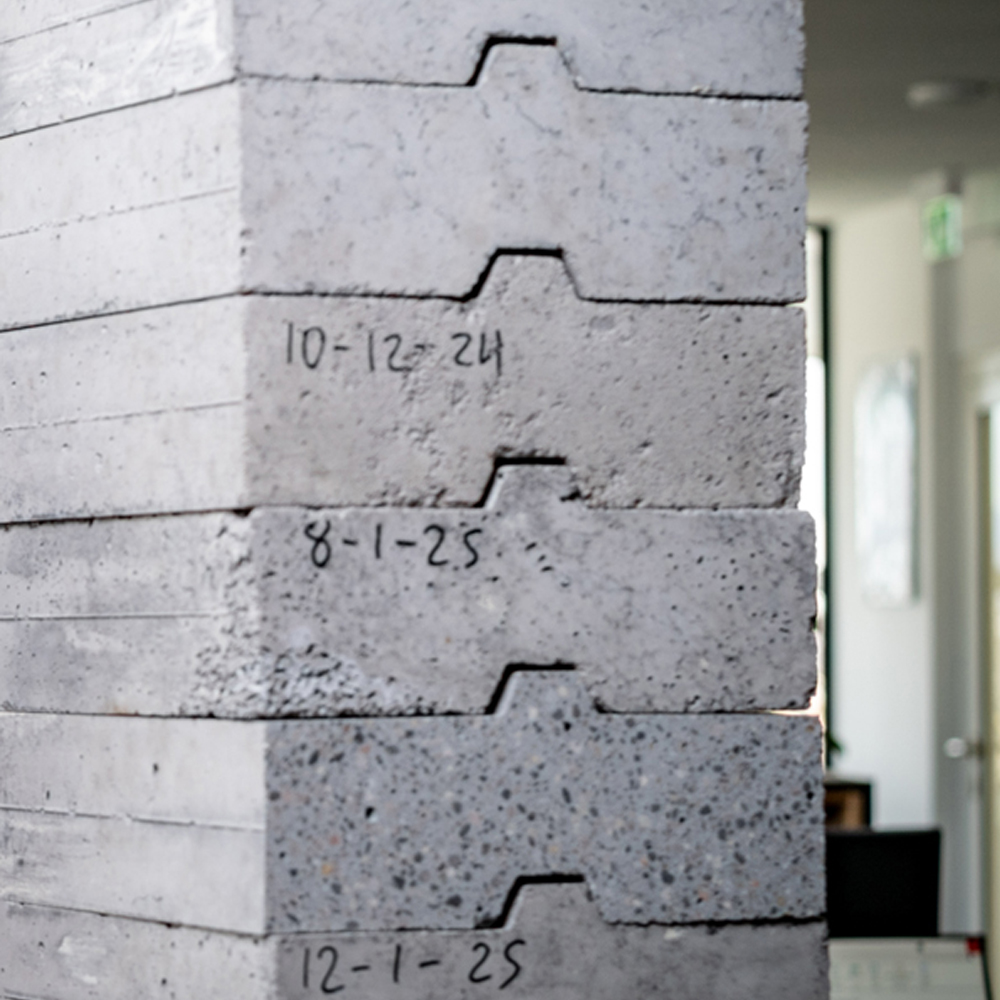
Recycled up to 100%
In terms of materials, RE.CK aims to replace sand and gravel entirely with recycled construction waste and, in the long term, to significantly reduce the cement content or replace it with alternative binders such as clays and ashes.
The current stage of development involves a formulation containing around 3 per cent cement, which already allows for practical curing and forms a solid basis for further development towards virtually cement-free systems.
Further development of the RE.CK system (formulations, binders, block geometries, production processes) is taking place in close collaboration between SQUARES for Tomorrow, the non-profit organisation Robins Places gGmbH, Polycare, STUDIO | Hammer | Schwiderski and academic partners (e.g. IAB Weimar and the University of Aleppo). Iterative test cycles involving laboratory and field trials are planned in order to adapt the RE.CK blocks to local raw materials, climatic conditions and regulatory requirements, and to realise virtually cement-free solutions.
Field Studies
In May and November 2025, and in June 2026, Alfons Schwiderski, together with his colleague Omar Halima, who is of Syrian origin, was able to gain a first-hand impression of the need for reconstruction, particularly in Aleppo.
A high proportion of buildings are damaged or uninhabitable, and neighbourhoods consist of landscapes of rubble. Traditional, heavily cement-based construction methods are reaching their limits here: cement and aggregates are expensive, in short supply and often only available via unreliable import routes; transport costs and risks further drive up construction costs.
There is a clear need for locally producible, resource-efficient building materials that utilise existing rubble as a raw material and function independently of fragile import chains.
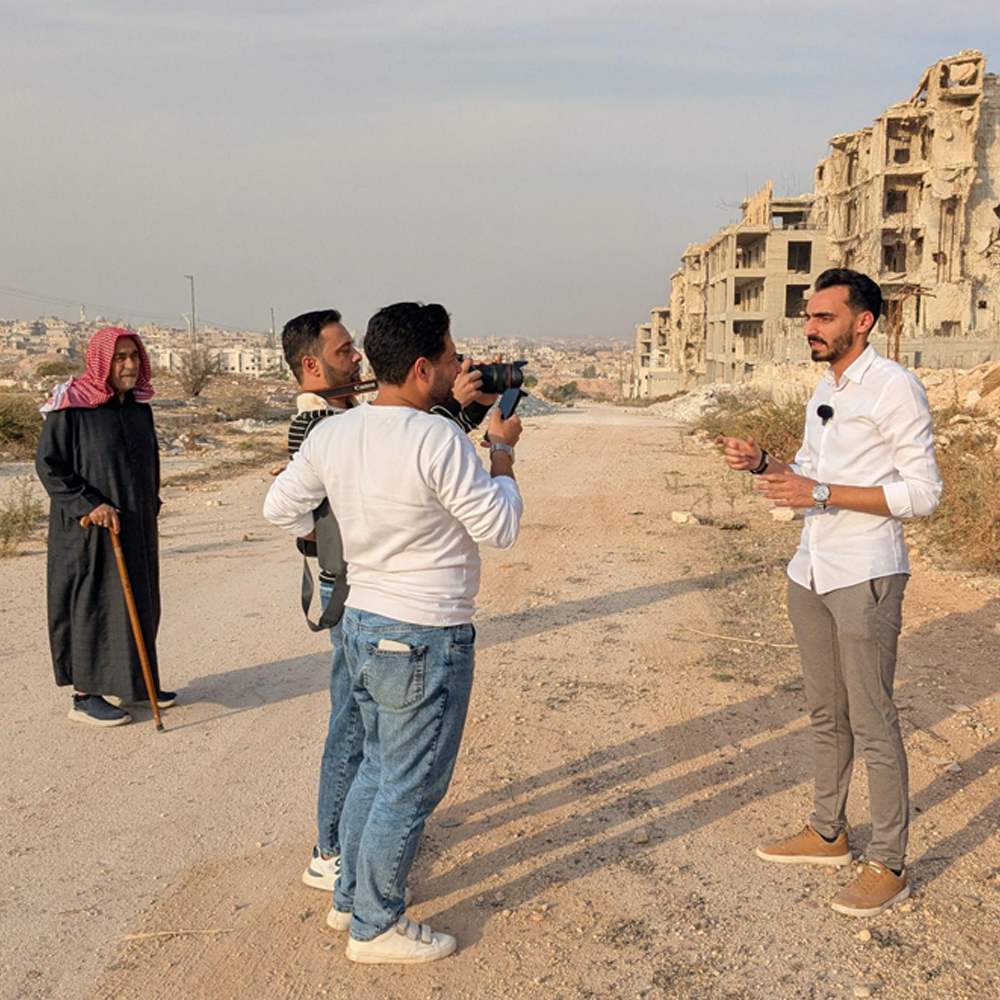
Omar Halima in an interview with Deutsche Welle in Aleppo
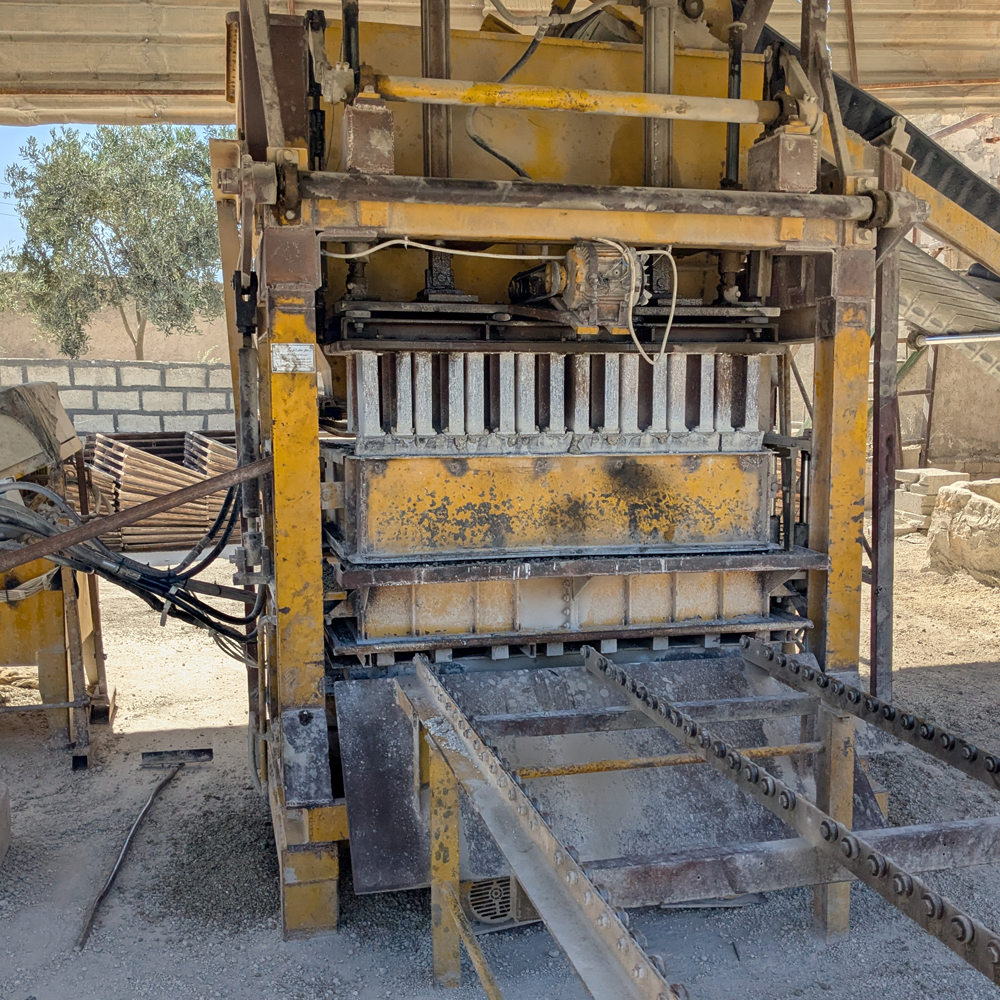
Production
The development objectives of the RE.CK system were deliberately aligned with the practices of construction waste recycling already widespread in the Middle East. In Syria and neighbouring countries, there is extensive experience with non-load-bearing recycled building materials and hollow blocks laid with mortar; load-bearing, solid recycled blocks without mortar or reinforcement, however, have not yet become established.
RE.CK bridges this gap by building on existing local expertise, machinery and recycling processes, whilst further developing them towards load-bearing, circular economy-oriented masonry systems.
Resource-efficient local construction
The RE.CK system uses locally available rubble as its main raw material, reduces the use of conventional cement through resource-efficient binders such as fly ash, and thereby lowers CO₂ emissions and material costs. Decentralised on-site production creates jobs in rubble processing, production, logistics and the building trades, and Syria – particularly Aleppo – is becoming an attractive model and reference market for a load-bearing, mortarless, circular masonry system.
Outlook:
In RE.CK’s micro-factories, rubble is set to be processed into safe building blocks with the aid of an AI platform: local teams record simple measurement data, from which the AI calculates site-specific mixtures and target compressive strengths and monitors the quality of each batch. This creates a learning production system that produces reliable building materials for reconstruction from challenging raw materials and integrates local people into AI-supported value creation. We are currently developing the concept for this ‘Production 2.0’.
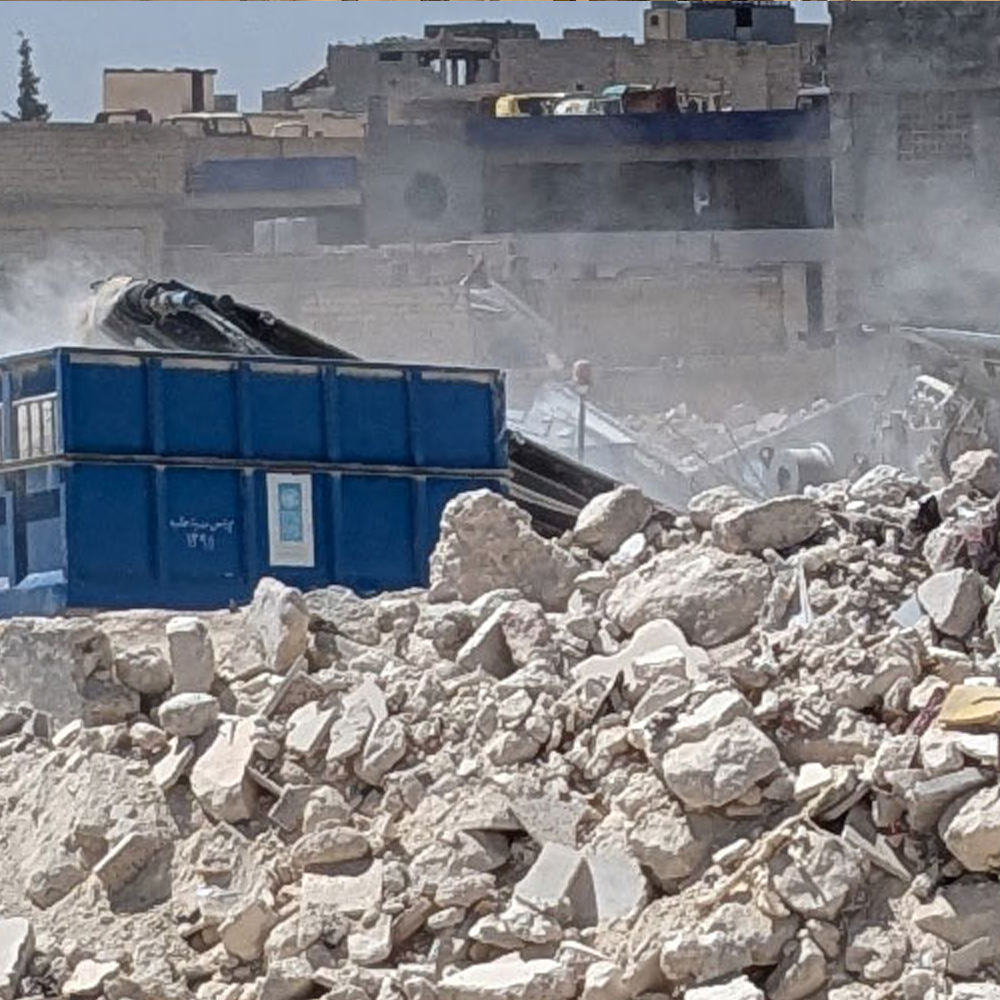
“When I see destroyed neighborhoods in Aleppo, I don’t just think about what’s been lost – I think about what can emerge from it. That’s exactly what RE.CK is about, no matter where in the world: building new hope out of destruction.“
Alfons Schwiderski, Civil Engineer, Inventor of RE.CK
We’d be happy to answer any questions you may have about RE.CK and/or our development work